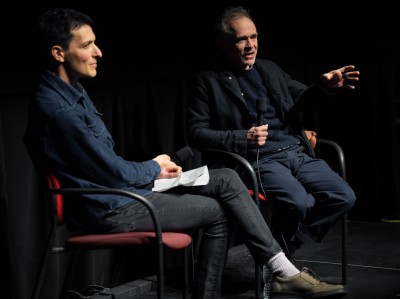
The Beguiled introduction and post-screening discussion with Haden Guest and Sofia Coppola.
Transcript
HADEN GUEST 0:01
Good evening, ladies and gentlemen. I want to thank you all for being here despite the truly awful weather, confirming that April is indeed the cruelest month. Nevertheless, I have the enormous pleasure to welcome tonight the celebrated American filmmaker Sofia Coppola, who joins us with her latest film, The Beguiled. A mesmerizing, sumptuous and masterfully understated film that rightfully earned her the Best Director’s Prize at last year's Cannes Film Festival. Many of you were here last night for the screening of a film bearing the same title from 1971: The Beguiled, directed by the great Don Siegel, and starring Clint Eastwood. This earlier film is a feverish, lurid and psychosexually intense Gothic fantasy, about a wounded Union soldier who finds himself in the care and strange world of a private girls’ school, deep in the countryside and dangerously close to the still-raging battlefield of the Civil War’s last bitter years. Sweaty, brooding and disturbingly graphic in its depiction of raw violence and errant sexual desire, Siegel’s The Beguiled unexpectedly anticipated the darkly misanthropic and misogynistic energies that would swirl around the eponymous hero of Siegel and Eastwood's best known and most controversial intervention from the following year: the ultra-violent San Francisco cop Dirty Harry. Sofia Coppola's film, in sharp contrast, offers a strikingly different and original reimagination of the earlier film, by drawing differently from its source novel to reshape essentially the same story with a completely new telling and tone.
One of the richest dimensions of Sofia Coppola's films is their rare ability to cast and to suspend a spell, to conjure dominant yet delicately floating mood expressed through careful accumulation of gestures, textures, colors, expressive objects. Coppola's interweaving of music and minimal dialogue is another powerful tool that is gently expanded across her films. Using these very means and others, the stark conflicts and simmering incestuous intensity of Don Siegel’s now cult film are carefully diffused to allow Coppola to pursue a very different agenda, to offer a group portrait of isolated, vulnerable, yet resolute women who together embody their difficult place in 19th century America and in the south in particular. While it makes for a really fascinating and thought-provoking program, these two films seen together, I want to make clear that Sofia Coppola's The Beguiled stands very clearly and assertively upon its own feet, and is moreover, perhaps best understood in light of Miss Coppola's other works.
Coppola’s films, in general, tend to take place in closed worlds: from the luxury hotels of Lost in Translation and Somewhere, to Marie Antoinette's palace, and the closed circle of celebrity-obsessed high schoolers in her often misunderstood The Bling Ring. These are privileged worlds that Coppola vividly evokes, and whose detachment and self-absorption she also subtly questions. Beginning with her now classic debut film, The Virgin Suicides, these closed worlds are described as largely the domain of women, as expressions then of the distinctly yet forcefully understated feminist charge that runs throughout Coppola’s work.
For Sofia Coppola is not only one of the most prominent women filmmakers active today, she's among the most important directors deeply invested in telling stories centered around women characters, around heroines most often caught in moments of difficult transition, suspended between worlds they are unable or perhaps unwilling to choose between. In her new film, Coppola explores a slightly different kind of closed woman's world, for the students and teachers of The Beguiled girls’ school are isolated less by their own choice than by the dark forces of history that cleaved a nation in two, a violent division that still reverberates across the US today. Coppola’s latest film is among her most political works in meditating on the specific hardship of women during this time of war. Much was made at the time of The Beguiled’s US release of Coppola's decision to deliberately not include the figure of Hattie, the African-American slave, who is another of the female voices in Siegel's film, and Thomas Cullinan’s novel. Coppola offered a thoughtful written response that made very clear her wish not to perpetuate the negative stereotype of African Americans of the film and novel, and nor to treat slavery as a background issue relegated to a side plot as she said. Coppola instead, as you will see, chose to carefully use the feminist lens, subtly defined across her films now, to explore the historical past in a novel and important new way. I ask you to be attentive to the subtly political and aesthetic meanings undergirding tonight's film, which offers a refreshing and rigorously different perspective on American history, and upon women's experience of the war.
I ask you to join me in conversation with Sofia Coppola about The Beguiled at the end of the screening. I'd also like to ask you to please turn off any cell phones, any electronic devices that you have, and please refrain from using them. And now, with no further ado, please join me in welcoming Sofia Coppola.
[APPLAUSE]
SOFIA COPPOLA 5:50
Thank you. Thank you. Thank you so much for coming on this rainy night and I'm so happy to be here. My friend Anna Sui, the designer, her niece Chase Sui is—are you here, Chase?—is a student here involved in the film program. And actually her sister was an intern on our set. And she invited me and I'm happy to, of course, come here. We filmed in New Orleans, not this past November, but the year before. And we shot the film in twenty-six or twenty-seven days. So it was an intense shoot on location there. Anyway, I hope you enjoy and I'm happy to answer questions after, and discuss Don Siegel's work and my work, and I hope you enjoy it. Okay. Thank you.
[APPLAUSE]
HADEN GUEST 7:24
Sofia Coppola. Thank you all for being here. I'll start with some questions. We can start the conversation here before opening up to questions and comments of your own. Let's start from the beginning. I'd love to hear how you came to this project, and how you came to this idea of returning to this film, The Beguiled by Don Siegel. Don Siegel, who represents old Hollywood in the sense that he was working in the 30s and 40s. Started as director of montage in the 30s at Warner Bros. and then starts making films himself. And by the time of The Beguiled, 1971, he's really a figure from old Hollywood in a time of the New Hollywood. The time, we also should mention, of your father's coming of age. So this film is at this crucial, sort of transitional period, and I was wondering if you could speak again, about your desire to return to this film, to return differently to it?
SOFIA COPPOLA 8:24
Yeah, I think of Don Siegel as being one of those macho guys of the 70s, and I grew up around that kind of mentality. I had never seen The Beguiled. I know him from his other more known work. nd my production designer and friend Anne Ross told me one day, “You have to see this movie The Beguiled. I think you need to remake this film.” And I thought, you know, “What are you talking about? I would never remake a film.” But I watched it and I knew what she was talking about. There were definitely things that reminded me, there were things that connected to, reminded me a little bit of The Virgin Suicides, my first film. And I just, you know, there was something about it that stayed with me. I kept thinking about it. Growing up in my household, the word “remake” is a bad word. My dad would say, “Nobody remakes a film unless they want to make money. And there's nothing, you know, artistic about” It was always like: “You never make a remake.” And I would never want to remake someone else's film. But I thought the story was so intriguing that I would love to tell this story, but my way, like how I would tell it. And I loved these—it had elements of The Virgin Suicides, but it was much darker. And it had women of different stages. It wasn't just teenage girls now. You know, there was the teacher and then the head mistress. And I thought it was so interesting to look at the kind of power dynamics between men and women, and these women at these different stages. And I also felt like a justice of– I wanted to give these women a fair voice, because they were so hysterical. And you know, the idea of sexuality and desire was crazy. And I thought, what was it really like for these women? And so I started kind of researching a little bit about that time, and I looked at the book by your president.
HADEN GUEST 10:25
By Drew Faust.
SOFIA COPPOLA 10:26
Drew Faust. Mothers of Invention. And there were a lot of journals of women living at that time. And I thought, what was it? What was the experience like? I don't know anything about the women of that time. The idea that they were so isolated and sort of abandoned their whole lives. We’re so different than how they grew up, and what that experience was like. I was intrigued by that. So that was the starting point of me thinking about how I would do this film, and in finding the book by Thomas Cullinan, which was very different. I've adapted books before, but it wasn’t like some book that I loved that I was trying to adapt. I knew about the story from the Don Siegel film, and I didn't want to retell his film. I wanted to go back to that story and now approach it as a film that I would make. That was the starting point.
HADEN GUEST 11:20
I'd like to speak a bit about some of the differences, and one of them being the figure of the soldier. For those of you who haven't seen the Don Siegel film, it's made very clear and very early on that he is a—how should we say it?—unreliable narrator. He's lying. There’s these flashbacks that reveal, he says he's a Quaker pacifist, cut to a flashback and we see him actually, you know, killing people, and doing so actually with a kind of vengeance. He says he loves the land and then we see him torching fields. You don't just remove this specific device, but you do something more. He's now an Irishman. He's also this gentler figure. There’s another kind of ambiguity at work, and I was wondering if you could speak about that.
SOFIA COPPOLA 12:17
Yeah, I mean to me my starting point was telling the story from the female characters’ point of view. So I thought, I want to be in their heads and trying to figure him out with them. And so instead of just coming in and we know he's a bad guy, I thought, let's bring him in and oh, he's like a wounded puppy dog and can we trust him? I hope we can trust him. And I think we've all been in situations with women, with looking at men like you probably shouldn't trust him but you want to, and so you go along with it. So I tried to be in their point of view of wanting to think he's okay. I thought it was more interesting to discover that as you go along in the story. And actually in the book, he was an Irish immigrant. When I met Colin Farrell, he's so charming in his native accent that I thought this just adds another element of him being exotic and foreign and more of a contrast. I really wanted a contrast between the masculine soldier and this very delicate woman's world—and he's dirty and scruffy and foreign—and make as much of a contrast and this kind of exotic intrigue.
HADEN GUEST 13:28
One of the points where I feel the film reaches a kind of magical moment is the dinner party, the first gathering. And it seems that the film enters almost into this fantasy realm where he first comes to dinner and suddenly these pastel dresses come out and we seem to be in another world. And it seems to me the sense of a sort of suspended world, closed world, a separate world. Is this something that has long intrigued you as a filmmaker? I was wondering if you could speak about this scene, and the place it occupies in that film, and perhaps how it might relate to this idea in other films, of course?
SOFIA COPPOLA 14:09
Yeah, I was thinking about… There's a line about how they brought out all their dresses from Christmas. Now they're abandoned. They're totally on their own and they're still holding on to this lifestyle that doesn't exist anymore. And they've stopped wearing their hoop skirts, I decided, because they're having to work in the field. But women at that time wore all these layers and hoop skirts and that. They dressed that way for men and they were raised to not do anything for themselves and just be delightful hostesses for gentlemen callers. And all of that was gone now. And when he comes back, I felt like they were ghosts living in some other era that now is gone. But they put on their jewelry and their hoop skirts again, and kind of do this whole pageantry to entertain this man. And Miss Martha's using it trying to justify to herself that they're harboring this prisoner. But it's a good example because she's teaching the girls, you know, how to entertain a man, but it's this lifestyle that doesn't exist anymore. So they're living in this kind of past and there was something sort of touching and demented about that.
HADEN GUEST 15:28
I love the way you say that they’re like ghosts because in fact when we see them, the first figures in the gardens, they are all striking in the whiteness of their clothing. So something wraith-like, if you will, about their appearance.
SOFIA COPPOLA 15:42
Yeah, when I first started thinking about the story, I really saw the palette that had to be these very faded pastels, and they've all had to wash these same dresses over and over, and they didn't have very much, and they're all kind of blended together. And I thought of them as being almost like a bouquet of flowers—they were all kind of part of one thing.
HADEN GUEST 16:02
Faded flowers.
SOFIA COPPOLA 16:03
Faded flowers, yeah. And I wanted them to be this kind of Southern, over-the-top idea of femininity. I think we're all raised with an idea of how women should be, but this was like the most extreme version of that. And that was one of the reasons, at one point someone said, you set it in another time. It has to be these Southern women because it's so an exaggeration of this femininity and how a lady should be. And even though I wasn't raised like that, there's still something left over from that culture of how you're supposed to behave. And so I was thinking about that, and then I also wanted to have this faded world of these kind of forgotten women that you know, you don't hear about. You hear about the much bigger stories of history at that time. So that sort of forgotten, fading flowers—and what was to become of them? Kirsten’s character was the most heartbreaking, because she’s raised to be a wife and then all the men are gone and he’s her last chance. And so thinking about that, that moment, and also a contrast in the art direction when he comes, he's in this faded delicate feminine world, and he's dark and masculine and scruffy. And just to see the contrast when he comes into their hothouse, and then as the story progresses, first he's on these delicate lacy pillows. And then as it starts to become clear that he's not a guest, he's more of a prisoner, the shades come down and he has a scratchy blanket instead of a pillow as they start to, you know—he's not so welcome. So I dunno, I was thinking about that kind of delicate idea, a feminine world.
HADEN GUEST 17:54
This is wonderful, the way you're speaking about this attention to these textures, these details. As I was saying before, this is the register in which you work, and this gives your films, I think, their subtlety and their nuance. And I wanted to talk a little bit about this, this idea of creating this mood, this place. I feel like so much of your films are about a particular place. And again, this is where the difference with the Siegel film is so striking. Here, the tension—the attraction and erotic tension—between the women and the soldier, you render in just these briefest of moments, right? The near kiss between Nicole Kidman and Colin Farrell is again so brief. I was wondering if you could speak about this decision, this strategy, to really, of understatement?
SOFIA COPPOLA 18:47
What I liked about the potential of the story was that it was so much about tension and sexual tension and all that's not being said and I think it's so fun as a writer to just–. You know, subtext is always the interesting part of dialogue. But for this, it was just so kind of over-the-top and blatant. And then to have it woven into this polite dialogue. I mean for me I think it was really fun just to have the exercise of just thinking about building tension and that's why there's not a score, that the score just has kind of these tones. So I was really thinking about working in a southern Gothic genre, which is something I've never done anything in genre and then about building tension and, and all the details. I've always liked the little details in life that I share with my films because to me, they say so much when someone stands too close or they almost kiss. Those moments are more impactful to me than some kind of full-out blown emotion because I feel like in life those are the moments that you remember as being some big moment that sounds like you know, nothing when you describe it. So I love those kind of moments.
HADEN GUEST 20:02
I mean, that said, Nicole Kidman comes the closest or brings us closest to the southern Gothic, I think, you know, the scene with the surgery book [SC: Oh, yeah!] and I was wondering if you could speak about—I mean, again, modulation like this because the way even her hairdo, you give these certain, I think, emphasis but yes she’s of another kind of cinema in a sense.
SOFIA COPPOLA 20:29
Yeah! I mean, I was having fun with it! I've never done anything like that! So, how to embrace all that and Gothic without being full camp. So we were straddling that. It wasn't like a full on spoof comedy, but we were, we were all cracking up when we were making it and watching Nicole you know, as Miss Martha and getting really into it, and that scene, when she amputates his leg. I'm gonna, I'm trying because I like subtlety. So how to do this in a way where you're not, you know, shooting blood everywhere but still, I love that genre of girls and nightgowns and blood and candelabras! [LAUGHTER] And that is a tradition that I was into and embracing for this movie. And when we're shooting that scene, I said, “Nicole, I really, really want that shot of you holding the candelabra saying…” What's the line she says? “Bring me the anatomy book!” That's the trailer moment. We have to get that. [LAUGHTER] And we were running out of time. We shot this very quickly and and then there was a tape where she like, held the candelabra and said that line with a blood drop on her forehead and a tendril of hair and like she just gave it to us, which she is so great at and, you know, and then we got it and moved on. But, you know, we, I think it helps having great actors and actresses that really can make something human and truthful, because that character could have been, you know, a total joke/spoof. And because Nicole took it seriously and really invested some humanity and made her sympathetic and she really believed that she was helping these girls. Um, I think it gives it that tone that I was hoping for, that it could be playful and fun, but still connected to some, you know, emotion and vulnerability.
HADEN GUEST 22:13
And no, I mean, I feel like this is great, the ways in which the film points to the genre, it points to the work that it's referencing at the same time is going to a whole other place. I feel like something else that is striking here, speaking about the costumes, I think that the expressive object and there's this wonderful sort of shot of Kirsten Dunst and that nightgown, and that we see that it's almost as if she's putting on this costume. It's this, you know, and it seems to have this history, this is something she's been saving for the man and, and I was wondering if you could speak about the importance of the expressive object and of costume and character because you have such attention throughout your films to clothing, to texture, to cloth, to the ways in which your characters present themselves to the world.
SOFIA COPPOLA 23:05
Yeah, I mean that moment with the nightgown, I remember reading that in the book, her unwrapping her nightgown from Paris and the tissue paper and yeah, that she saved it for her trousseau or whatever. And, this is her last moment to wear it, so I remember that having an impact and how to show that visually. But I think because I've always loved fashion and clothes and costumes, that's something that I focused on. I worked as a costume designer before, but it's just always been an interest of mine. So that's something that even when I'm writing, I think about the character and what they're wearing, because I think it expresses, it can tell you one more clue to who that character is. And so something that I think about, and something like this, I enjoy working on that, because well it's fun to do period costume but to think about the colors and building this world. And I think it's fun for the actresses to wear these kind of clothes that we don't wear anymore. But I guess that’s my girly side. I like clothes and it's fun to build the character through that.
HADEN GUEST 24:12
You also have a predilection to the–. Characters are constantly in your films lying down, lying in repose. It seems there are beds that appear throughout the films, often in non-erotic means. And I love the way here you have the character of the soldier is immediately put to bed and it's almost like a maternal bed at first, he is being sort of tucked in and then it becomes an erotic bed as well. I’m wondering if you could speak about the–
SOFIA COPPOLA 24:38
The lounging?
HADEN GUEST 24:40
Yeah, but not only that, I mean again I'm thinking about Lost in Translation, the bed there. It's a sort of state of mind almost, right? Of being suspended, of being half asleep, half awake?
SOFIA COPPOLA 24:48
Yeah, I mean, I guess I started my first film Virgin Suicides because teenage girls in my idea lounge around a lot and you lie around in your bedroom and daydream. And so I just think that is part of the female experience, although I don't spend a lot of time (at least not now) lying around but, um, so I don't know, I guess I just I thought … in this situation, I think that's what the character would do. But with him, so much of it was about him being a wounded soldier and comes in as their guest, and yes they tuck him in and then it turns into his prison. And it was sort of fun, definitely, having him be the object. We were all very clear about that, you know, that he's the object and he's at their mercy and Colin Farrell was a good sport about that. But I mean, he spent the whole movie lying on a lacy pillow with women tending to him and then torturing him, I guess, but yeah, it was fun to get to switch and play with the power roles of him being their victim.
HADEN GUEST 25:56
Let's take some questions and comments from the audience. And if you just raise your hand? And we'll start with the gentlemen in the very back corner, will you just wait for the microphone and then everybody can hear you.
AUDIENCE 1 26:08
I'm always fascinated by when you write a screenplay, where to begin, and where to end the story. The death of the soldier, there's still some conflict between the women of the house; I'm wondering: did you contemplate going further, deeper in at you know, three weeks, three months, a period afterwards, and how the the dynamics of the house changed as a result of his death and this very traumatic event taking place?
SOFIA COPPOLA 26:36
Yeah, for me, the ending of the story, the beginning of the story is him arriving at this house and he thinks like, he really made it. It's like, you know, heaven having these women tending to him. And then the end of the story is his departure in a body bag out of the gate. So that really felt like the ending and I had this image I wrote of them sitting on the steps waiting behind the gate and those bars becoming like a prison and they're waiting for someone to come pick up the bag but I like that it's not really a happy ending because they're trapped in this world that doesn't exist and they're kind of prisoners of this lifestyle. So I thought that was a strong ending of you know them just trapped waiting behind the bars of the gate.
HADEN GUEST 27:29
We'll take a question right here in the front. That'd be great. Who's first? Thank you.
AUDIENCE 2 27:39
I was wondering regarding the use of the light throughout the film, particularly regarding the soldier. In the beginning, it seems like there's a lighter kind of light reflecting in his face. He has more brilliance, let's say, and as the film progresses, it turns a little bit darker. It seems to sort of show how he's changing in the way of his characters and I was wondering if you can speak a little bit more about it. And also I was wondering regarding the use of French in the lessons the girls were receiving, if you connected that also with the sexual tension that was being built.
SOFIA COPPOLA 28:31
So the first part about the lighting, yes, we definitely thought about the lighting shifting throughout the story and in the beginning. We don't want him to be threatening. We want to be kind of seeing him as this, you know, romantic, nice guest to have and then as the story progresses, we realize that he's a threat and so the whole lighting changes in the last section, but especially him. He's more harsh and scary looking instead of soft and potentially romantic and the thought in the, I guess, the last act is that it becomes more Gothic looking and there's more extreme angles and it's more dark and and then in contrast to the stark setting, and I wanted it to feel claustrophobic, too. So a lot of that. It's all set in that house and as we filmed there's less outside and more windows closed and to try to have a claustrophobic feeling. And the second question was that … oh, the use of French? Oh, it was fashionable for women at that time to use French phrases [HG: The use of the French language, right.] so I just thought it was funny that–
HADEN GUEST 29:46
It’s also from the original…? Oh yeah, there is a French lesson at the beginning.
SOFIA COPPOLA 29:51
Oh, yeah, yeah, there is in the movie but also it was just a fashion at that time. So I tried to throw in, kind of pepper Miss Martha’s speech as much as possible with little French phrases because it was fashion at that time, which is another–. They're just out in the middle of nowhere and they're still trying to connect to being “continental” and you know, European. I thought it was just another link to this lifestyle that is not gonna happen for them.
HADEN GUEST 30:17
Other questions? Let’s take the woman in the middle right there with your hand? Yeah.
AUDIENCE 3 30:25
I was very interested in the use of music in the movie, in the score, because I was thinking about your previous movies and I noticed that music was very important in those previous movies. And here, it's only present in certain specific moments of tension, but it's not like all over the film, so I was wondering about that. Thank you very much.
HADEN GUEST 30:43
Yes, very striking in this film compared to your other works.
SOFIA COPPOLA 30:47
Yeah, it's true. I've always used music a lot and enjoyed putting songs in and in this I really wanted the sound design to be the focal point and to feel the starkness. And I wanted to make it minimal, that it really felt like you're cut off from the world with them, and I feel like music always relieves the tension, so to try to build tension to not have that. And to feel the cannons in the distance and the sounds of nature and kind of them trapped far away from the rest of the world was the thinking. And then I asked Phoenix to do some kind of electronic tones that just kind of underscore the tension, and I felt like I always wanted some music that wasn't of the period, to sort of, I don't know, to frame just this tension and have some kind of separation from the time.
HADEN GUEST 31:42
Also the human voice though, the acapella singing, I feel like that gives a certain breathing, childlike quality. I mean, you set a tone right at the beginning with that.
SOFIA COPPOLA 31:52
Yeah, when the girls sing, I mean, so we thought that it would only be the source music for the actual songs of the ones they sing. Then when the girls sing, it's so touching when you hear the child singing, and I thought at the end it has this kind of haunting quality and innocence. And so, yeah, exactly their fragility and how vulnerable they are. And there's something touching about the girls’ scene. And they were some Broadway kids.
HADEN GUEST 32:21
Yes, the gentleman in the white shirt here?
AUDIENCE 4 32:26
Hi, I saw the Don Siegel version last night. And it's really striking, You know, the contrast between the two. I mean, you see the connections, but I, I guess I was curious how you thought about that film when you were making your film. I mean, obviously you'd seen it. Were you trying to stay far away from it? Were you trying not to? Or would it not cross your mind? You know, how did you think about that film?
SOPHIA COPPOLA 32:58
Yeah, I mean, I was definitely… It’s my first impression of the story. So, my starting points came from the film. And then I got the book and looked into it but it wasn't like this beloved book of mine that I was adapting. I was thinking about it from the film. But then I tried to forget the film. I didn't watch it for a while until after we finished the film. And then there were things I was like, Oh, I didn't realize that I had that in my mind. It was kind of like a foggy dream. So I have regard for that film, and I love it for what it is. So it didn't mean to be disrespectful at all in making mine, but I definitely wanted to make kind of the women's side of it. But I did try to forget that film and then just approach it how I would make it but it was definitely you know, when I saw it, I first thought of Kirsten, because of Elizabeth Hartman playing the teacher and I was kind of doing my version of it and then I tried to approach it in a new way.
HADEN GUEST 33:58
We could take this gentleman up here. If you just wait for the microphone?
AUDIENCE 5 34:09
I thought the performance of Nicole Kidman was really remarkable, because she holds herself together, she holds herself very tight, but then she's always on the verge of a breakdown and then, you know, obviously she amputates the leg when perhaps it is not necessary. It is really, really well played. So how much is her or you're directing her to this? Because I think she does something very remarkable.
SOFIA COPPOLA 34:41
Okay. Yeah, no, I loved watching her, and I talked to her before about what I had in mind for the character and then I think she just imagined what it would be like for that character. And she's the one holding it all together. And I mean, yeah, she seems like on the verge of a breakdown because, I don't know, wouldn’t you be if you were in that situation? And kind of holding it together for everyone else. So we talked about the character and then I think she was able to put something into it that she connected to. I always saw that character as a little bit crazy, but I knew that Nicole would bring something relatable, because she could easily be just an arch villain. And I like that she bought something human to her. So I always think, maybe you don't know, like did she need to cut it off? Or did she not? I like that you can go either way and you can kind of relate to her and she's nuts at the same time.
HADEN GUEST 35:36
Let's take someone there in the back.
AUDIENCE 6 35:44
Thank you very much for your presence and for the movie. My question has two parts. The first part is: you filmed almost in a chiaroscuro style. How much your relationship to your director of photography, Mr. Le Sourd, influenced the way [it looks] and how much did you influence him? And my second question is: you are, in my view, heavily informed from paintings, how much Fragonard painting as well as Boucher has influenced this movie?
SOFIA COPPOLA 36:23
Oh, thank you. I worked very closely with Philippe Le Sourd, the cinematographer, and that's a great you know, pleasure to me and such a big part of telling the story and we, we looked at a lot of references and we looked at photos and a lot of paintings as references and we wanted it to feel as naturalistic as possible because the story is so melodramatic for me, to make it as naturalistic as possible and to feel that's not like a big Hollywood version of that time, but naturalistic and that it's all natural light even and that it's lit by candles. And much as you can, I always want the audience to feel like they're with the characters, experiencing what they're experiencing in that world. So that was the goal, and then Philippe and I looked at paintings of that time to get that look but mostly how it could really look for that time. And the composition and the framing gets closer as the story progresses to feel more claustrophobic, but the scene with the silk dresses at night with the candles, it reminded me of some of the painting references. And then I also love photography and I even had references like Eggleston to show him for girls sitting on the couch. So I like mixing references from other eras too.
HADEN GUEST 37:57
So what were some of the other of these photo references, I’m curious to know. Are there others?
SOFIA COPPOLA 38:02
I can't remember directly but there was an Eggleston photo of two girls talking on a couch. So there's a scene with Elle and the other girl talking about like, “Are we gonna let him stay?” and we have the intimacy and the patterns of the dresses with the pattern of the sofa behind them. And then there was like a photograph of Steve McQueen holding a hose, pouring water over his head—I don't ever if you’ve ever seen that—which is when Colin’s working in the garden, we thought of him having some heartthrob moments. So yeah, we were having fun with all that, but we definitely looked at paintings and also a lot of portraiture of the time for the styling of the women, because I wanted them to be relatable. So picking the clothes and even the hairstyles, we would pick ones that looked less foreign to a modern eye and edit them to pick the ones that were more relatable, so that you could hopefully not look at them as these weird distant people, but relatable. So that was what went into how we picked which clothes and hair and all those things.
HADEN GUEST 39:13
So let's take a couple more questions. WE seem to have a lot from the front. The woman in the striped shirt?
AUDIENCE 7 39:23
Thank you. I'm curious what you find to be the most challenging, maybe in this work, but in your practice in general.
SOFIA COPPOLA 39:39
What do I find to be most challenging? I feel when I start a film, it’s always challenging. And by the end, I don't know how you get through it. Somehow you do. So I find writing, that part of it, that's the hardest part for me. And then you get on set and then there's a time constraint which is hard. But I find it interesting to work under a tight timeframe, because you have to have creative solutions. I think each film has its own challenge. I think on this, one of the things that was hard or was a struggle, talking about the differences between them, is looking at the character of Hattie, the slave, and deciding not to include that character and how to treat that. I didn't want to–. When I read journals of the time, there were these women that talked about they woke up one morning and everyone was gone, all the slaves had escaped and all the people that had been taking care of them, everyone was gone, and they didn't know how to do anything for themselves. And so I thought about this experience, and I felt like Thomas Cullinan, his kind of pulpy book, threw this character in that felt like a token character. It didn't really seem accurate to me, that one slave would just stay behind to help Miss Martha or whatever. So it seemed more realistic to me to be closer to these women's journals. But like thinking about how to treat this and you know, I want to be respectful, and it was misinterpreted and so that to me was the big challenge of how to deal with that aspect of the history, which wasn't what our story was about and how to be respectful of that. I think that was for me, one of the hardest parts to figure out.
HADEN GUEST 41:26
I feel like your period films, you do this, there’s a quality of a deep respect for that past. I think of Marie Antoinette as well. But then also a willful, not irreverence, but just a wanting to mark this as a film of today as well, too. And I think that's something that's difficult. That's difficult to achieve.
SOFIA COPPOLA 41:48
Yeah, no, I think there's a history in film, of having like a token, that the only colored person is the token servant, and I didn't want to continue that. That's something that's in our film history that I didn't want to have my film be. Obviously I don't want to continue that. But with Marie Antoinette I could be more playful. With that one I thought could be more irreverent because I felt like they're teenagers and Marie Antoinette, she wouldn’t go by the book, she would do it her way. So I felt like I can be a little bit more punk about the history of that. And with this, I wanted to be closer to the history just because it's such a tragic time for our country, to treat it with some respect, but then get into who are these women? and the melodrama and be playful with that.
HADEN GUEST 42:48
Let's just take a couple more questions. So the woman with glasses there on the side to the left, and we'll do one more ....
AUDIENCE 8 42:56
Sofia, thank you for coming. Thank you for your film. I was wondering, what's your thought process as a director behind that sex/rape scene, which is so, you know, so intense. There's so many contradictions within the scene: she goes into this room, and she, you know, gives herself to him. And then in the meantime, Nicole's character is making us think, right, she's like, holding everyone and is like, I have to think, I have to think and it's also making us as an audience, think about the scene or whatever is going on in that other room. So I think it was a really remarkable scene. And I would love to know your thought process behind it as a director.
SOFIA COPPOLA 43:41
Yeah, I always find sex scenes really hard and embarrassing to shoot. Yeah, just like it's awkward. You're asking the actors to, you know, be in a situation and I want to be sensitive to them and how you portray it. Yeah, I always find those challenging. But in that scene, I feel like—or hopefully that—there's tension throughout the whole movie, that it's like finally the scene with the bodice ripper. [HG: The sound of the buttons!] And for the first take, we had loosened all the buttons so they would come off easily, and he ripped it open and you could hear them all on the floor, and it was like yes, we had our bodice ripper moment! So and it was like yes, finally, you know, you’re kind of happy for her and that I love—which actually came from the Don Siegel movie—I remember when that character comes in the room, she like uses all her might to push the sofa to block the door, and to me that was like the most intense moment, not what happens after, but just seeing her use all her might to block the door and so I think in this film she moved the table, but we put like all these sandbags on the table so it was really hard to push and she had to use all her might. That moment to me was like a culmination of everything. And also that character is so repressed and buttoned-up that I just feel like it's, I don't know, like you're relieved and it’s great that she finally lets loose and just lets him throw her on the floor. I feel she's giving herself to him, so I don't feel like he's attacking her, but she's kind of inviting him…
HADEN GUEST 45:21
Her sealing the door is a pretty—
SOPHIA COPPOLA 45:22
Yeah, exactly. So, yeah, I love that she finally kind of goes for it with him.
HADEN GUEST 45:30
Right. Let's take one last question right here in front. We can wait for the -- ?
AUDIENCE 9 45:37
Thank you very much for being here, talking to us. As I watched the movie, I thought this is almost a Robinson Crusoe for women. Nicole Kidman lives on an island. Her plantation is all fenced. It's all locked. She sees herself as a survivor. The men are at war. And the women, for one reason or another, they could not leave Richmond. (It seems to be outside of Richmond.) And however, she's a very strong woman. She never had any doubts about herself. She knows that when she could have screamed to the line of Confederate soldiers, “Come over here, I got a surprise for you.” But all along she knew how to solve. She was a problem solver. She did not know anything about taking care of his leg but she could do it. She was a kind woman, she wanted him to survive. She was decent. And then at the end, she was confronted with evil. This man was evil. He was a Soldier of Fortune. Yes. It's a very strong movie about what do you do when you are confronted with so much evil around you even when you thought that you were doing good? And at the end, instead of sitting in one of the girls [sound fades out].
HADEN GUEST 47:24
A question perhaps about the ethics of– [SC: It’s a question?] I don't think it's really a question.
[INAUDIBLE AUDIENCE COMMENT]
Well, no, we appreciate it and I love the Robinson Crusoe connection. So I’d like to ask you to please join me in thanking Sofia Coppola for this film!
SOFIA COPPOLA 47:51
Thank you. Thank you.
[APPLAUSE]
Related film series
Explore more conversations
Scott MacDonald, Robb Moss & Stephanie Spray

Rita Azevedo Gomes

Francisco Valente
Ben Rivers