Dreileben
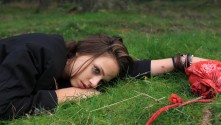
In the summer of 2006, members of the “Berlin School” – the latest wave of German filmmakers whose work has been seen primarily in film festivals and art houses – began a lengthy correspondence discussing the current state of that country’s cinema. Participating were Germany’s three leading filmmakers – Christian Petzold (b. 1960), Dominik Graf (b. 1952) and Christoph Hochhäusler (b. 1972). Graf launched the discussion by positing that the films of the Berlin School privileged visual style over narrative, overlooking the role of language in cinema; hence seeming to downplay or even deny the possibility of communication between the characters onscreen. This opening salvo generated a great deal of soul-searching about the usefulness and limits of genre filmmaking and the joys and discontents of auteurism. Ultimately, the three agreed to make a trilogy of interlocking films, all taking place in the same location and linked by one event: the escape of a convicted murderer.
The films are independent of one another – each has its own plot, so that each can be understood on its own – and they can be seen in any order. At the same time, the experience of each film is deepened by seeing the others. Together, the trilogy constructs a narrative maze whose labyrinthine depths hints at other partially concealed stories – which mostly involve the lives of the police – branching off from the central manhunt thread: the aging detective with a bad ear and failure of a son he keeps at arm’s length; the hothead cop who’s quick to fire his weapon and even quicker to lose his temper; and hints of corruption within the force. Living up to its origins in the debate over genre, narrative and auteurism, Dreileben moves swiftly through a vast array of storytelling genres: fairy tale, horror film, suspense thriller, character study, love story.
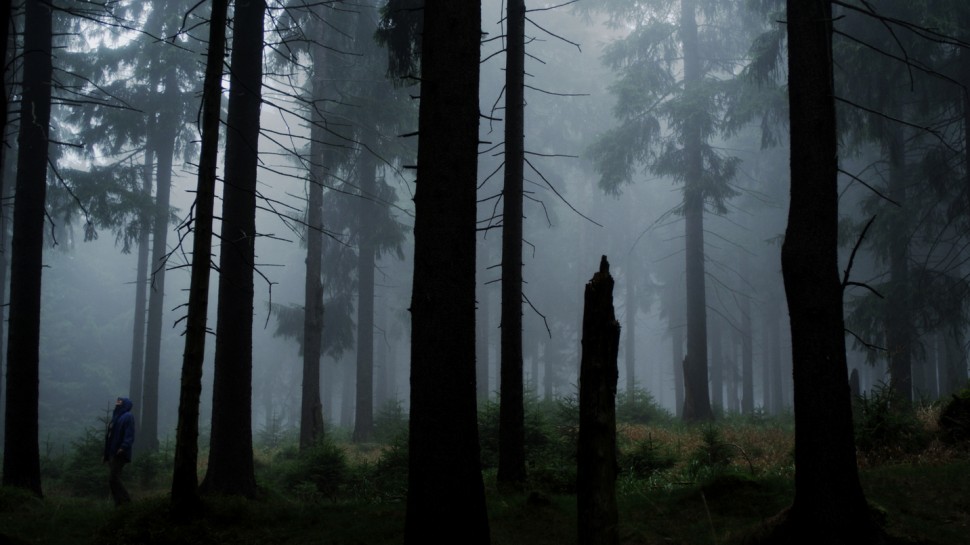
Above all what emerges is the portrait of Dreileben (“Drei” is German for “three,” and “drei leben” could be translated as “three lives”) a fictional small town in Thuringia, the heavily forested state at the heart of Germany. Besides its central location, Thuringia can also be seen as a focal point of recent German history (it was part of East Germany) and legend (the location of the mythic resting place of Frederick I, aka Barbarossa). And indeed, both historical and legendary past intrude into the daily lives of the Dreileben inhabitants onscreen. – David Pendleto
Dreileben will also screen at ArtsEmerson during the weekends of Feb. 3 and 10.