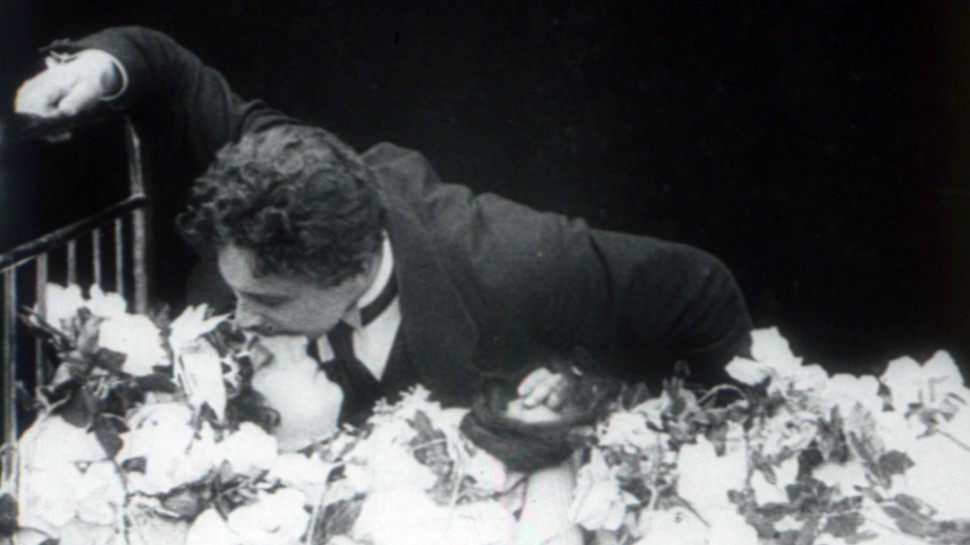
Child of the Big City
Daydreams
Live Musical Accompaniment
Screening on Film
$10 Special Event Tickets
Yevgenii Bauer (1867-1917) is generally considered the most important of Russia's pre-Revolutionary filmmakers, although he was later condemned as a "decadent" by official Soviet histories. His work is informed by the Art Nouveau aesthetics and Symbolist sensibility characteristic of turn-of-the-century Russian culture as a whole. Coming to film relatively late after beginning his career as a set designer for the stage, Bauer experimented with effects lighting, camera movement, complex staging and visual uses of interior architecture, often taking those techniques to new extremes.
This Bauer program is a prologue to Dziga Vertov and the Soviet Avant-Garde, a series of screenings of Soviet cinema hosted by renowned scholar of Russian and Soviet cinema Yuri Tsivian, which will run on Mondays in March and April.
Live piano accompaniment by Martin Marks.
PROGRAM
-
Child of the Big City (Ditia bolhsogo goroda)
Directed by Yevgenii Bauer.
With Elena Smirnova, G. Iost.
Russia, 1914, 35mm, black & white, silent, 45 min.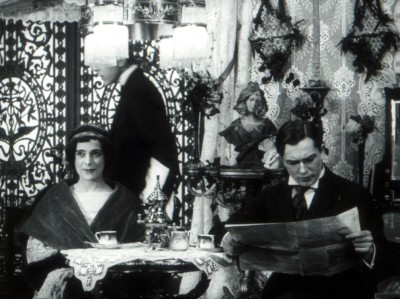
Child of the Big City is a Russian version of a vamp movie, with a touch that makes it different from other stories about poor girls who drain and ruin rich men. 1914 was Russia's craze year for the tango. Elena Smirnova, as the heartless seducer, and G. Iost, as the lover whom she prefers over the unfortunate (and wealthy) suitor who keeps her, are two Moscow ballroom dancers who were already famous as a tango couple. Watch for the bold overhead dolly-in over restaurant tables homing in on a cabaret dancer who happens to be Bauer's wife, Lina.
-
Daydreams (Grezy)
Directed by Yevgenii Bauer.
With Alexander Wyrubow, N. Tschernobajewa, F. Werchowzewa.
Russia, 1915, 35mm, black & white, silent, 45 min.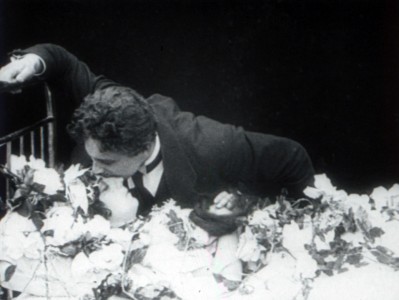
A screen version of George Rodenbach's novel Bruges-la- Morte, Daydreams was cinema's first attempt to handle Symbolist prose. Much as in Vertigo (for which Rodenbach was an uncredited source), a dead woman comes back into a man's life as her exact double, in body if not in soul. Unable to go to Bruges (the famous dead city at the turn of the 20th century, today swarming with tourists because of its fame), Bauer laboriously recreates its empty streets in the usually busy and lively Moscow. Mysterious dolly shots make the settings even more haunting.
“I would rather die than give away the harrowing ending.” – Yuri Tsivian