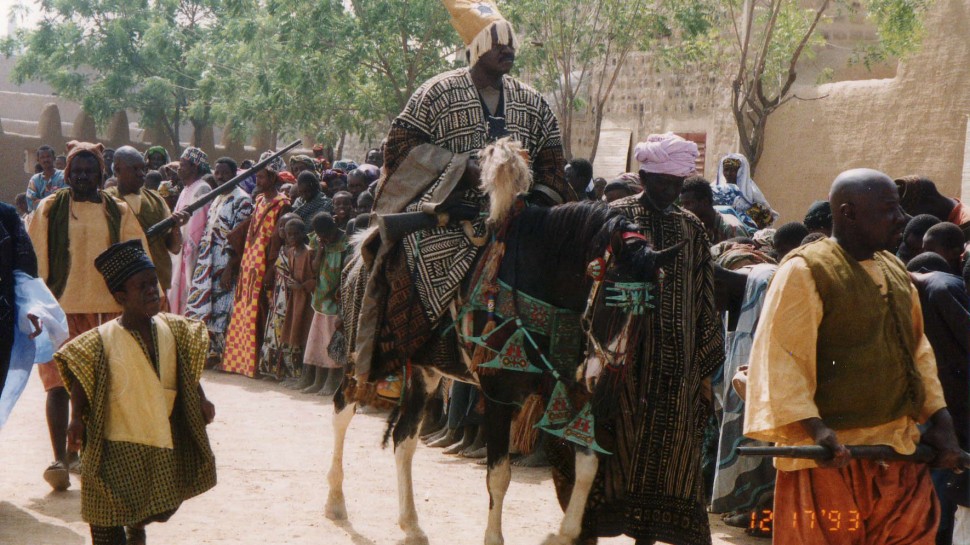
Guimba the Tyrant
(Guimba, un tyrant une époque)
Screening on Film
With Falabo Issa Traore, Bala Moussa Keita, Habib Dembele.
Mali, 1995, 35mm, color, 93 min.
Bambara with English subtitles.
Print source: Kino International
The Harvard Film Archive welcomes the recent recipient of the Genevieve McMillan-Reba Stewart Fellowship, renowned Malian filmmaker Cheick Oumar Sissoko, with a screening of his acclaimed 1996 film Guimba the Tyrant, an allegorical re-telling of an important moment in recent Malian history, the 1991 overthrow of Moussa Traore. After Sissoko’s neorealist feature debut Nyamanton (1986) and the tragicomic agitprop of Finzan (1989), and before the epic sweep and Biblical grandeur of Genesis (1999), Sissoko’s third feature provides further evidence of Sissoko’s talent and the variety of his work. – David Pendleton
Set in a prosperous (and mythic) city-state in the pre-colonial era, Guimba the Tyrant is both broadly comic and pointedly political in its tale of the fall of a dictator. The title character rules in large part by creating spectacle to display his power, which gives Sissoko the excuse to create a lavish and imaginative mise-en-scene of intricate masks, costumes and rituals. The film draws upon two traditional Malian forms of discourse: kotéba, a popular form of satiric street theatre, and baro, a virtuoso kind of public oratory. "Guimba is a political film, a fable about power, its atrocities and its absurdities. I was personally influenced by what I experienced not long ago in Mali, but the ravages of power are, unfortunately, universal." – Cheick Oumar Sissoko