Basil Bunting
Lambing
-
Basil Bunting
Directed by Peter Bell.
UK, 1982, digital video, color, 37 min.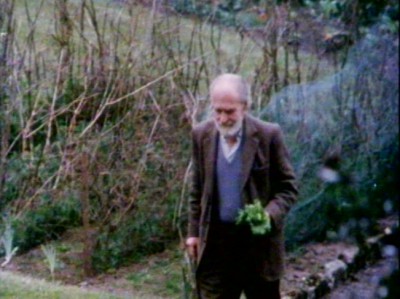
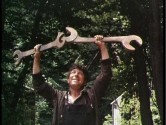
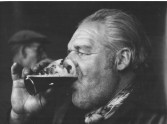
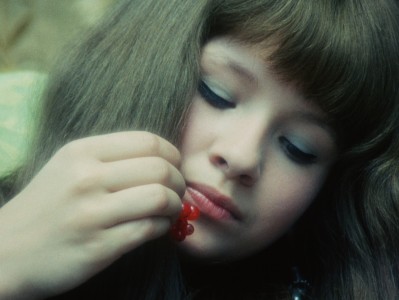
A lot of this production had been beautifully shot by members of the Amber film co-op, when I was asked to shape and edit the material. The film is based on Basil Bunting’s magnificent recording of his autobiographical poem “Briggflats.” Bunting believed strongly that the sound of poetry being read aloud was far more informative than extracting meaning from the page. The poem refers to the rhythm and sound of Scarlatti’s music: it takes us on journeys through aspects of Bunting’s extraordinary life: his life as a Quaker and as a conscientious objector (1918), as a sailor or in Italy with Ezra Pound, and in Persia where he was an Intelligence officer, Times correspondent and assistant to the consul. But above all, the poem constantly returns to his adolescent love for a young girl in the North of England, where the heart of the poem resides.
While editing, I separated Bunting’s reflections on poetry or quiet thoughts on life from the progression of the poem; sometimes the gentleness of his voice turns these words into a form of poetry. At one point, we accompany him on his journey to “Briggflats” where much of his adolescence was spent. As his little car speeds through a big landscape of northern hills, Bunting’s wonderful rendering of the poem recalls ancient kings, their legendry battles for land... and his own relentless search for the truth.
-
Lambing
Directed by Philip Trevelyan.
UK, 1964, 16mm, black & white, 26 min.
Print source: filmmaker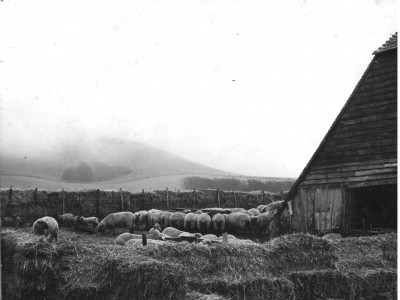
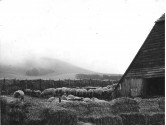
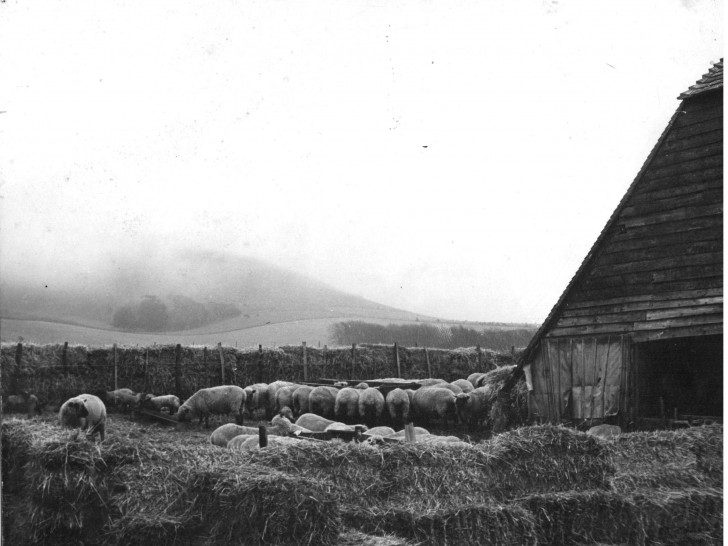
This is a film about a traditional Sussex shepherd who we follow from morning to night, through snow and wind, as he works alone with his flock. This was my first proper journey into filmmaking, and my subject was a person I had worked for and admired as a boy. We used an Arriflex camera with fixed lenses and occasionally resorted to a simple wind-up camera. No electricity was used for any lighting and all sound was “wild.”
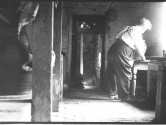
The film is constructed from carefully edited moments in the shepherd’s routine work. His passing comments about how to deliver or feed lambs are our only guide. He sometimes reflects on the difficulties he encounters, such as the deaths of lambs or the bitterly cold snowfall. On the whole, we learn that he loves his work and that he is happy when resting in his chair by the fire, making a cup of tea or warming milk for the orphan lambs. If the film has a climax, it is captured in the struggle of a ewe giving birth to its lamb. The film ends as the evening turns to night and the shepherd returns to his chair by a warm fire: he pulls a blanket over himself and quietly sings himself to sleep.
Part of film series
Screenings from this program
The Moon and the Sledgehammer