Snow White
(Branca de Neve)
With Maria Do Carmo Rôlo, Ana Brandão, Reginaldo da Cruz.
Portugal, 2000, DCP, color, 75 min.
Portuguese with English subtitles.
DCP source: Cinema Guild
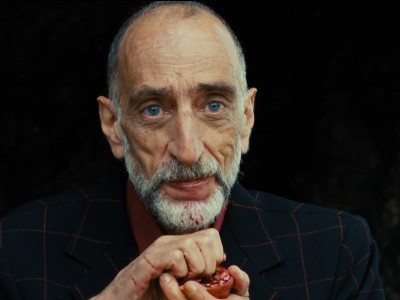
Monteiro moved far away from the visual opulence defined by his earlier films with his inspired adaptation of radical Swiss writer Robert Walser’s anti-fairy tale. Carefully restricting the image track, Monteiro maintains an almost totally black screen in order to focus instead on the voices of Snow White, the Prince, the Queen and the Hunter, engaged in an extended debate about love, free will and the events leading up to the fateful attempt on the maiden’s life. Despite its visual austerity, Snow White is haunted by the arresting images with which it begins—infamous black-and-white photographs of Walser lying dead in the snow after his heart attack outside a Swiss asylum at the age of seventy-eight, a strange realization of the “death of the author” so central to postmodern literary criticism.
ON SEPTEMBER 14 PRECEDED BY
-
He Who Awaits Dead Man’s Shoes Dies Barefoot: A Cinematographic Proverb (Quem Espera por Sapatos de Defunto Morre Descalço: Um Provérbio Cinematográfico)
Directed by João César Monteiro.
With Antónia Brandão, Luís Miguel Cintra, Paula Ferreira.
Portugal, 1970, DCP, black & white, 35 min.
Portuguese with English subtitles.
DCP source: Cinema Guild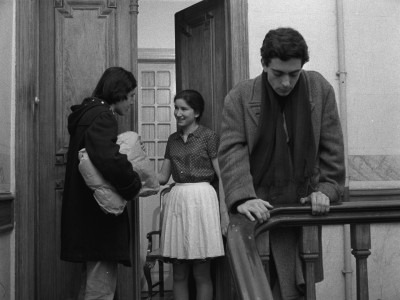
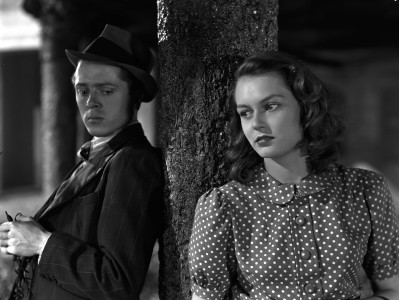
Monteiro’s second film immediately declares his radical ludic spirit with its fragmentary portrait of a restless young man, a lovelorn thinker with artistic ambitions played by a preternaturally young Luís Miguel Cintra. While He Who Awaits … makes openly clear its debt to Godard, who is prominently quoted, it also earnestly asks what original language is most appropriate for a new Portugal cinema, as explored in the pre-credit prologue, a sequence of outtakes, featuring Monteiro himself, presented as expressions of futility.