Visions of Eight
The Suspended Step of the Stork
There will be a 15-minute intermission between films. The Suspended Step of the Stork will begin around 4:10pm.
PROGRAM
-
Visions of Eight
Directed by Miloš Forman, Ichikawa Kon, Arthur Penn, Claude Lelouch, Yuriy Ozerov, Michael Pfleghar, John Schlesinger, Mai Zetterling.
West Germany/US , 1973, 35mm, color, 110 min.
Print source: Harvard Film Archive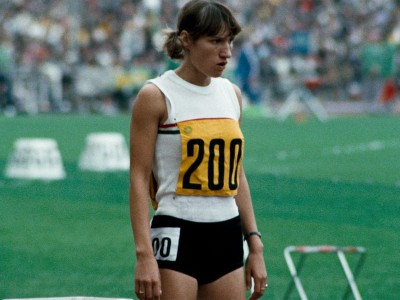
Just as the Olympics serves as a beacon for international athletes, this portmanteau documentary compiles segments from acclaimed filmmakers across the world—John Schlesinger, Claude Lelouch and Ichikawa Kon, to name a few—who each present a unique perspective of the 1972 Munich Summer Games. The Games had last been held in Germany in 1936 under the Third Reich and were famously documented by Leni Riefenstahl to delineate the mythic “superhuman” Aryan from the rest of the world. Visions of Eight’s coalition, however, celebrates the Olympics actively challenging those myths. Take Arthur Penn’s “The Highest,” where competing pole vaulters are united in their Icarian pursuit rather than pitted against one another, or Miloš Forman’s comic, vaudevillian undercutting of the Games’ pomp and circumstance. These cinematic beams converge in the prismatic Visions of Eight to posit that the Olympics are not important because they remind us of our ability to transcend humanity, but because they bring us face-to-face with it. – Gunnar Sizemore ‘27
-
The Suspended Step of the Stork (To meteoro vima tou pelargou)
Directed by Theo Angelopoulos.
With Gregory Patrikareas, Marcello Mastroianni, Jeanne Moreau.
Greece, 1991, 35mm, color, 142 min.
Greek with English subtitles.
Print source: Harvard Film Archive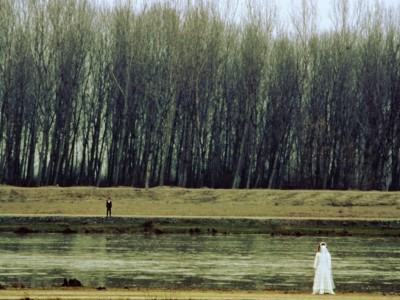
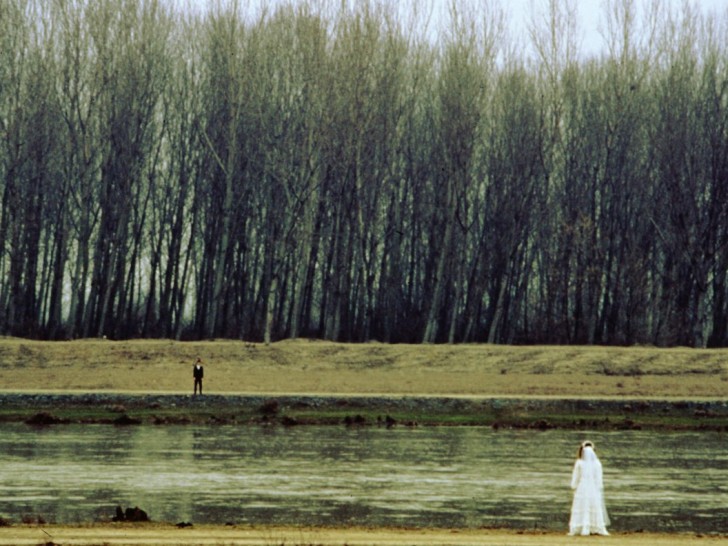
Raised amid German occupation and civil war, Theo Angelopoulos pivoted from law studies in Greece to Parisian film school, cultivating a cinema of long, borderless takes; a porous interplay between reportage and myth; and a keen interest in the opposing forces of fascism and resistance. The Suspended Step of the Stork sits squarely in this legacy, a poetic inquiry into what constitutes community in moments of displacement. Set along the Greece–Albania frontier just as Albania’s Stalinist regime begins to collapse, the film follows a journalist (Gregory Patrikareas) searching for a vanished politician (Marcello Mastroianni) amid refugee encampments and zones of enforced waiting. The film focuses on the concept of belonging—geographic, historical, communal, personal—and here the border is a line that divides nations while creating new forms of fragile community. Sometimes the line is as delicate as a glance across a dance hall or as definitive as a treacherous militarized boundary. Angelopoulos goes further, asking, how do borders shape not only nations and individuals, but cinema itself? – Clara Aranovich, Visiting Fellow
Part of film series
Screenings from this program
Funeral Parade of Roses / Land of Silence and Darkness