The Adventures of Lotte Reiniger
Animated films were supposed to make people roar with laughter…. Everybody to whom we talked in the industry about the proposition was horrified. But we did not belong to the industry. We always had been outsiders and we always had done what we wanted to do.
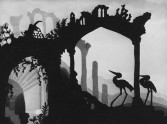
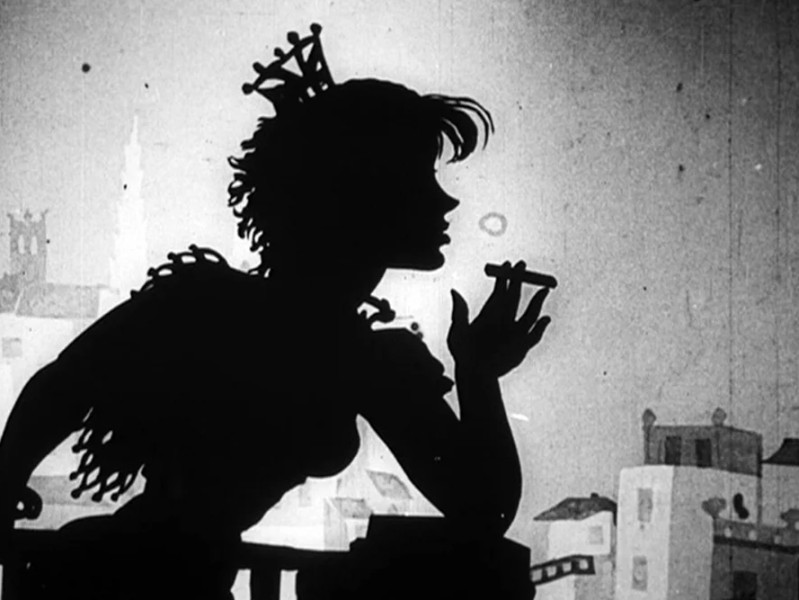
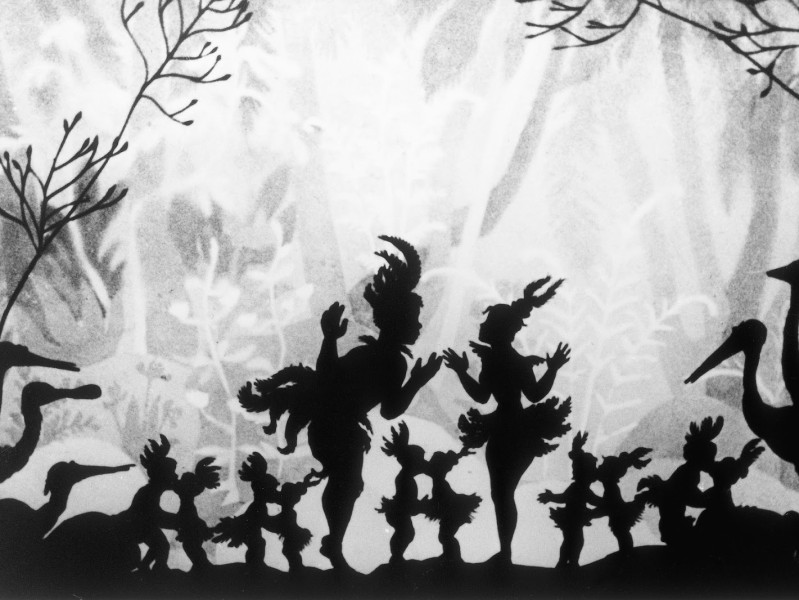
Finally acknowledged for creating the earliest surviving animated feature film in 1926, The Adventures of Prince Achmed, Lotte Reiniger (1899 – 1981) flourished on her own cinematic planet by making intricately cut-out silhouettes dance on screen in Prince Achmed as well as dozens of short films, interstitials in features and commercials. She was on the forefront of the burgeoning art form as a co-inventor (with her husband) of a multiplane animation set-up; she was a pioneer of an entire film genre and style; and she remained an independent, female filmmaker in a male- and studio-dominated industry. In addition to her film work—which included one live-action experiment—she was an illustrator, costume and set designer, shadow puppet performer, poet, author and lecturer.
Though she directed a complex, feature-length film that involved creating new machines and animation techniques, synchronizing movement with music, coordinating a large crew and closely collaborating with other artists and composers, Reiniger has been routinely left out of the cinematic canon, primarily stemming from her womanhood, modesty and independence—as well the association with craft and children’s entertainment. For decades, even Reiniger’s major claims to fame were subverted by Walt Disney, who took credit for both the multiplane camera system and for making the first animated feature with Snow White and the Seven Dwarfs (1937)—both accomplished several years after Reiniger’s feats. Further aiding her future neglect was Prince Achmed’s premiering at a time when anti-German sentiment was steadily growing. In the US, Prince Achmed was distributed by Harvard’s erstwhile University Film Foundation which, according to scholar Donald Crafton, did so little to promote it that the film’s theatrical release in this country did not occur until 1942.
In her words, Reiniger started cutting silhouettes “almost as soon as I could manage to hold a pair of scissors.” Made from cut paper yet much cheaper than a painting, the shadow profile portrait was particularly popular in Europe during the 18th century and again in the early photographic and mechanical age, partly because of its graphic style, useful in illustrations and advertisements. The silhouette was both elegant and economical, representational and abstract. During her acting studies and exposure to early film experimentation in Weimar Berlin, Reiniger discovered that this new, spectral medium provided the ideal dimension for her silhouettes to come to magical life. Inspired by the traditional shadow theaters of China, Turkey, Greece and Indonesia, Reiniger almost exclusively animated the fantastic worlds of fables, myths and fairy tales throughout her prolific career.
In her Weimar days, Reiniger was surrounded by figures of the celebrated Der absolute Film group—like Walter Ruttmann, Hans Richter and Viking Eggeling—who regarded pure abstraction as the consummate cinema. Despite working on segments of Prince Achmed alongside her, even Ruttmann thought her work was out of touch with the times. Reiniger herself was famously self-deprecating, and admitted she was not part of the zeitgeist. She appears to have valued artistic freedom over fame and fortune in her reluctance to join any particular art movement or the studio system, and she ultimately fled from another controlling force, the Third Reich.
She was also a founding member of the bustling Berlin chapter of the experimental animation studio Institute for Cultural Research where she met Carl Koch, her husband and artistic partner. Among her many famous fans and collaborators—Bertolt Brecht, Benjamin Britten, Hans Richter—was her lifelong friend Jean Renoir; she created an animated shadow sequence for his film La Marseillaise (1938). After she and her husband moved from Germany to London for a second time in the 1950s, she enjoyed a fruitful relationship with an independent studio that produced over a dozen of her fairy tale shorts for television. Upon Koch’s death in 1963, Reiniger turned to her various other artistic outlets, eventually returning to film to make a couple of shorts in the 70s.
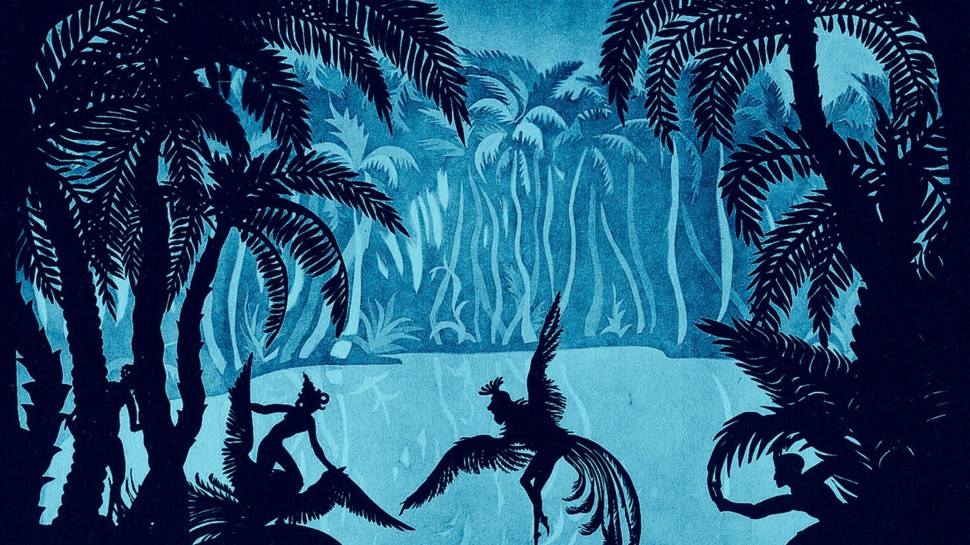
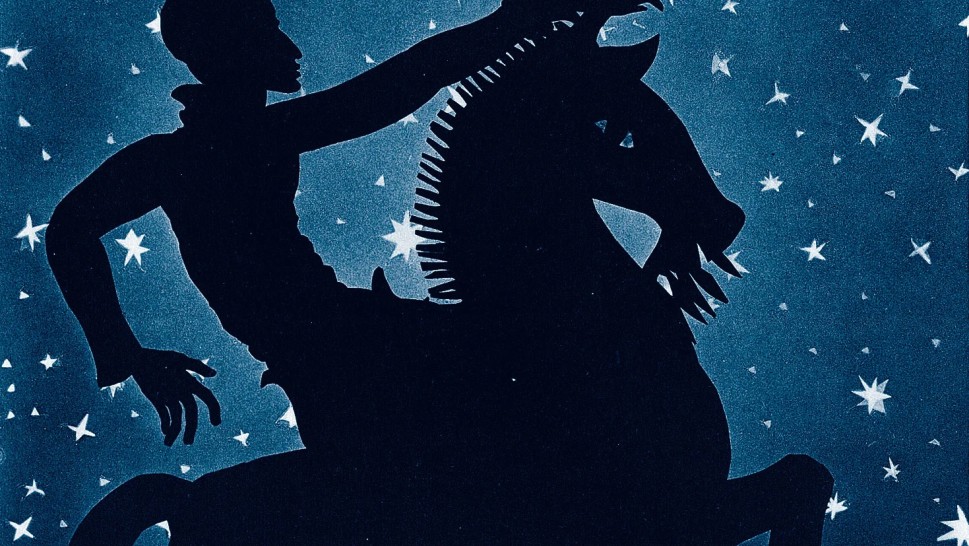
Her crowning achievement, Prince Achmed, was a subtly radical expression, the depths of which scholars have only begun to explore within the past several years. She elegantly combined populist art genres—silhouette cutting, animated film and folktales—into a lush and fantastic narrative that was worlds away from the cartoon comedy shorts of the time. Neither silly nor avant-garde, the film was not even “traditional” drawn animation; this was a variety of cinema no one had witnessed before, and it unfolded across an expansive canvas.
With this film, Reiniger marries progressivism with tradition, populist art with cutting-edge technology, machine with handmade, naturalism with theatricality. Scholar Vivian K. Taylor even makes the case that “Prince Achmed reflects the encounter between various competing Weimar cultural movements by displaying traits valued not only by Expressionism, but also by Bauhaus, Constructivism, Surrealism, and New Objectivity.” Content-wise, the film is at times refreshingly enlightened—she included homoerotic scenes, including one that was ultimately censored, in an effort to depict same-sex love as natural and romantic—yet it is not without the problem of Orientalism and negative stereotypes which Reiniger acknowledged later in her life. And like many aspects of the film, the role of women remains complicated and open to speculation over the degree to which she was commenting on female subjugation.
Reiniger embraced an idealistic universalism through a mostly dialogue-free, shadowy art that is inherently mysterious and magical: Prince Achmed’s flickering world is filled with screens and scrims, forest alcoves and caves, remote mountaintops and disappearing castles, echoing the subconscious. Leaving certain details to the imagination, silhouette films require a more participatory viewing experience, and she felt similarly about black and white— that it left room for the mind to imagine its own colors. Even to media-jaded eyes today, the wonder of Reiniger’s films is inescapable and invites new audiences to make their own discoveries within its alternate dimensions. – Brittany Gravely
Past screenings from this program
The Adventures of Prince Achmed