Freedom Outside Reason
The Animated Cinema of Jan Lenica
Program Three
-
Once Upon a Time… (Byl sobie raz)
Directed by Walerian Borowczyk and Jan Lenica.
Poland, 1957, digital video, color, 9 min.
Copy source: Film Studio KADR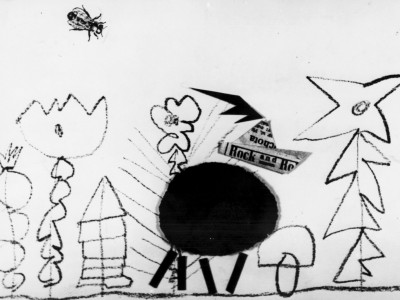
The first film from Borowczyk and Lenica is a burst of freedom from any aesthetic or content restrictions. With children’s drawings as the background, their abstract, cut-out characters free-associate in a decidely absurd, adult manner—ultimately revolutionizing animation in Poland and beyond.
-
New Janko the Musician (Nowy Janko Muzykant)
Directed by Jan Lenica.
Poland, 1960, digital video, color, 10 min.
Copy source: Studio Miniatur Filmowych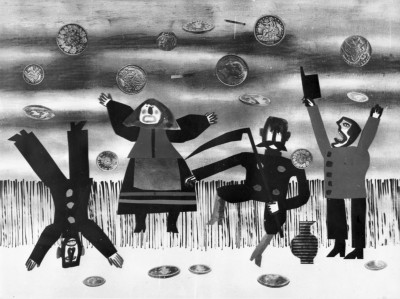
In addition to contemporary anachronisms and surreal disjunctions, Lenica removes the tragedy from Henryk Sienkiewicz’ tale of a musically gifted peasant and inserts some social justice in the form of cosmic intervention.
-
Fantorro, the Last Arbiter (Fantorro, le dernier justicier)
Directed by Jan Lenica.
With Stan Hayward.
France, 1971, digital video, color, 11 min.
Copy source: Argos Film
Lenica’s comic book figure Fantorro—the name a combination of the sadistic Fantômas and the heroic Zorro—is an out-of-shape, very ordinary looking caped crusader whose escapades turn many a storytime trope upside-down and inside-out. As if flipping through a series of slender comic books, Lenica brings four vignettes to life with collage animation and animated photos. The cynical cycles move from Fantorro aiding and abetting a “damsel in distress;” a villain counterfeiting money using pages of Marx’s Das Kapital; a struggling, suicidal scientist whose latest experiment enlarges his ear to an enormous size; and a grand, fantastic finale combining satiric takes on many of Lenica’s ongoing obsessions: wealth, spectacle, conformity, technology, control, freedom and, of course, happy endings.
-
Labyrinth (Labirynt)
Directed by Jan Lenica.
Poland, 1961, digital video, color, 8 min.
Copy source: HFA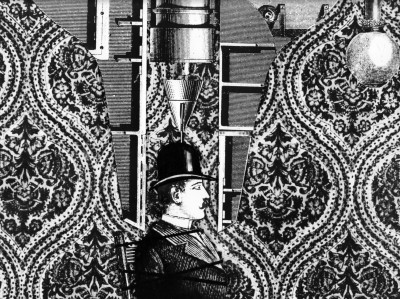
One of Lenica’s most famous films is an apocalyptic dreamscape constructed from a disconcerting menagerie of Victorian illustration cut-outs in the spirit of Max Ernst. An Icarus-like figure flies into an unusual ghost town, where floating heads, ambulatory dinosaur skeletons, giant bugs and other mutations make vaguely ominous appearances. The visitor’s attempts to participate in Lenica’s sci-fi fairytale through traditional means—such as slaying the dragon and saving the damsel—do not go as planned, and he is instead subjected to much less heroic trials and “processing.” Despite its playful appearance, Lenica’s carnivalesque world is one of irreverent deception and illusion at the mercy of a greater, darker force.
-
Landscape
With vestiges of creatures from the films that came before, Lenica’s expressionistic, enigmatic Landscape seems propelled by somber, more melancholic energies. At a young age, Lenica narrowly escaped concentration camp internment and witnessed gruesome horrors of war. Though oppressive regimes, senseless catastrophe and deep disillusion haunt all of his films, the dreamy ache of Landscape seems to signify a more personal catharsis unfolding. Though softer-edged and hand-drawn, his fossil-like forms are riddled with wounds, scars, disease and dismemberment that slice beyond the physical plane to the psychic. Garby Leon’s otherworldly soundtrack resonates the beauty and the pain of existing in a world layered with allusion and code, yet denying complete comprehension. “Landscape seduces the viewer by being only partly textual,” notes writer Steve Weiner. “That is, there are half-formed metaphors and blatant symbols that invite a reading but deny answers.”
-
Monsieur Tête
Directed by Jan Lenica and Henri Gruel.
France, 1959, 16mm, color, 13 min.
Print source: Harvard Film Archive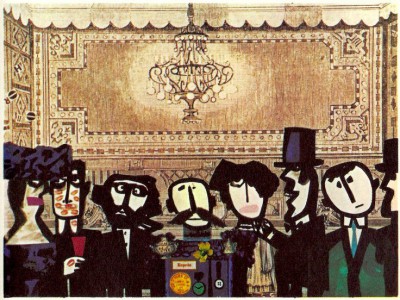
“Aided by Eugène Ionesco,” this film is laced with Lenica’s usual charming pessimism and disruptive surrealism. His animated expressionist drawings alternate with more intricate collage cut-outs to tell the story of a Lenician Everyman bitten by “the serpent of revolt” yet caught up in the mindless, absurd bureaucracy and utilitarian machinery of modern life. The mindlessness literally catches up with him, and he loses his head, which “thinks too much” anyway and only seems to get him into trouble. Whether or not his exchanging individuality for conformity is a good idea, it is hard not to read a bit of self-referentialism into the much-acclaimed artist depicting the character’s facial features disappearing with each honor he receives.