Revolução
A Lei da Terra
On April 25th, 1974, The Carnation Revolution brought down forty-eight years of dictatorship in Portugal. Under the revolutionary commotion, filmmakers and numerous emerging militant film production units dedicated their work to listening to the real country, while actively intervening in the revolution they were recording. Although with different orientations and aesthetic inclinations, all productions from that period are traversed by political, social, cultural and economic upheavals and formally express, with greater or lesser degrees of evidence, a subversion of the previously established order with a new freedom of discourse—no longer under the gaze of the dictator and the censorship previously imposed on Portuguese cinema. After filming the large rallies in the city of Lisbon, the attention shifted to the rural areas. Several film crews moved from the urban fabric to the countryside to make films with and for the people. Two films made during the revolutionary period focused on the symbolic and effective appropriations carried out by the people. — Marta Mateus
PROGRAM
-
Revolução
Directed by Ana Hatherly.
Portugal, 1975, DCP, color, 12 min.
Portuguese with English subtitles.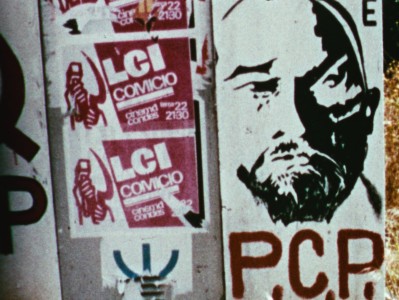
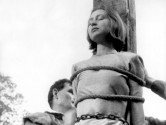
Made during the PREC (Ongoing Revolutionary Process), Revolução documents with effervescence the saturation and vitality of traces, signs, symbols, figures and words that occupied and intervened in the public space immediately after the Carnation Revolution. The film registers a multiplicity of painted murals, graffiti, propaganda posters from various political factions and previously banned parties—some with long clandestine activities—as a diversity of emerging new parties, accompanied by a roaring chorus composed of speeches of prominent resistance figures, the crowds' jubilant demonstrations and the previously forbidden songs of protest. The montage of image and sound juxtaposes profuse layers of vibration within a series of continuous shocks, evincing the buzz of euphoric collective participation in the construction of a new democratic country. Ana Hatherly's work crisscrosses several fields, from poetry to the visual arts, partaking in the richness of these intersections and inscribing itself as a revolutionary act. — Marta Mateus
-
A Lei da Terra (The Law of the Land)
Directed by Grupo Zero.
Portugal, 1977, DCP, color, 67 min.
Portuguese with English subtitles.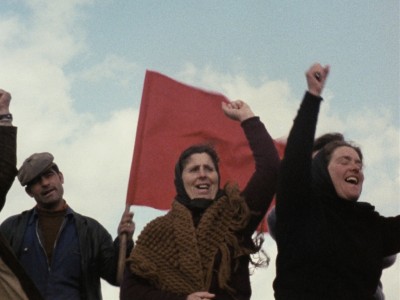
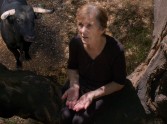
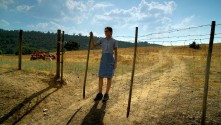
By the end of 1975, under the motto “The land belongs to those who work it,” more than a million hectares of land were occupied, especially in the southern fields of Alentejo, one of the poorest regions in the country. Having started as an unregulated occupy movement, the Agrarian Reform Laws later approved by the Council of the Revolution set in motion the expropriation and nationalization of large landholdings considered fundamental for the development of the country and its citizens. The UCP's (Collective Production Units) were formed and run mainly by peasants and casual rural workers, some of the most disadvantaged and precarious citizens.
"Venturing to speak with the peasants is the secret of A Lei da Terra,” asserted director Seixas Santos, one of the members of the Grupo Zero cooperative. The film accompanies the struggle of some of these rural workers and peasants during the Agrarian Reform process in Alentejo. An important record of the post-revolutionary period, framing the events in their countless social, political and historical manifestations, contributing to a contextualization and reflection on the dynamics of class struggle and the issues of land ownership and possession to this day. Through female and male voiceover dialogue in a reportage style with didactic preoccupations, the film documents—and comments on—one of the most intense moments experienced in the fields of the south and during the entire post-revolutionary period. In resonance with the reality they face and revealing the many layers of complexity in its reflective construction, the film breathes at the pace of the people across the bright and colorful landscape, forming a communion that breaks with the gloom of the days before. — Marta Mateus
Part of film series
Screenings from this program


Program IV


Fire of Wind